Which One Would You Pick? Build a Habit of Testing Your Marketing.
One tool. Two headlines. Which one makes you want to try it? Start with an emoji pick, then build a testing habit across your ads, pages, lead magnets, and follow-up.
Manno NotermansFounder at Think Orion · 7 min read
Leave an emoji pick
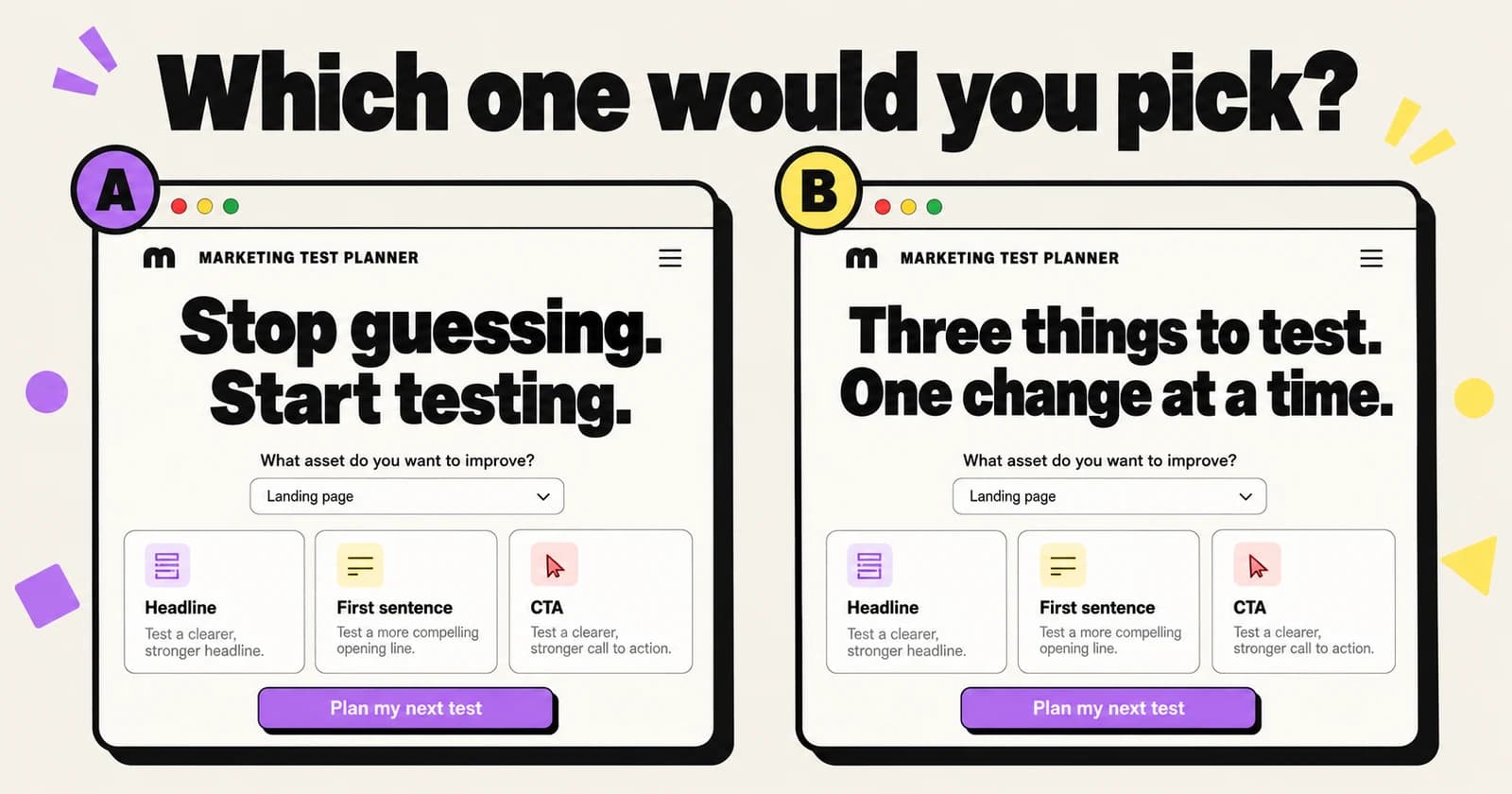
Which one would you pick?
Same Marketing Test Planner. Two headlines. Which one makes you want to try it?
Loading reader picks…
One pick per browser; you can change it. An informal preference poll.
Your pick tells us which headline interests you. A marketing test would measure which version helps the intended audience start a useful plan.
Here are two ways to introduce the same free Marketing Test Planner.
Version A: “Stop guessing. Start testing.”
Version B: “Three things to test. One change at a time.”
The tool, its features, and the next step stay the same. Only the headline changes. Which version makes you more interested in trying it?
One headline speaks to the frustration of guessing. The other makes the process feel concrete. Your pick gives us a useful starting question.
To learn which headline helps the intended audience take the next step, we would need to compare the versions in a real test.
The same thing happens when we review marketing. We pick the headline we like. We choose the image that feels more professional. We replace a sentence because someone in the meeting would never say it that way.
Those reactions can give us ideas worth investigating. The next move is to turn an idea into a test.
Choose 🟣 for headline A, “Stop guessing. Start testing.” Choose 🟡 for headline B, “Three things to test. One change at a time.” Leave your pick in the poll above and see what other readers chose.
This is an informal preference poll. It tells us which option people chose in this setting. It does not tell us which headline would bring more suitable people into the planner, or whether those people would go on to create a useful test plan.
That gap is the point of the exercise. A preference starts the conversation. A useful test connects the choice to the job.
Give each marketing asset three things to keep testing
The whole journey contains opportunities to learn. The ad has to earn a relevant visit. The page has to make the promise understandable. The lead magnet needs to be worth choosing. The thank-you page has to continue the journey. The follow-up needs to make sense in the context of what the person just did.
You could change dozens of things in each one. That is a difficult habit to sustain.
Start with three elements for each format. Keep them in a small queue. When one test finishes, return to the queue with what you learned.
Image ad: the first sentence of primary text, the image concept, and the headline.
Video ad: the opening spoken line, the first sentence of primary text, and the end-card invitation.
Landing page: the hero headline, the first supporting sentence, and the main CTA label.
Guide or download: the title, the first promise sentence, and the opt-in CTA.
Thank-you page: the confirmation headline, the first next-step sentence, and the next-action label.
Follow-up email: the subject line, the first sentence, and the main CTA wording.
These are practical starting points, not a universal ranking of what matters most. A broken form needs fixing before another headline comparison. A misleading promise needs correcting before you optimise clicks. The material and the problem should guide the next test.
Three elements in the queue. One change in the test.
Having three elements to keep testing does not mean changing all three together.
If you replace the headline, image, opening sentence, audience, and page at once, you may learn whether that new combination performs differently. You will have a harder time explaining which individual edit caused the difference.
For a test of one element, give that element the room to answer a clear question. Hold the rest of the experience and delivery conditions as steady as the experiment allows.
Google's Campaign Experiments guidance recommends focusing on a single variable, deciding on a primary measure, and avoiding changes to the comparison campaigns while the experiment runs.
That does not make every advertising interface a clean laboratory. Dynamic formats can mix assets and delivery can differ. Use an experiment setup that can isolate the change you want to understand.
Write the reason before you write the challenger
“The headline looks boring” is a reaction. It can be useful, but it is not yet an explanation of what might improve.
Try: “The headline names a skill, but the buyer is thinking about a problem at work. Connecting the promise to that situation may make the page more relevant.”
Now the challenger has a job.
Current headline: “Build your data analysis skills.”
Challenger: “Make a stronger case in your next team meeting.”
Keep the supporting copy, offer, and next step the same. Before running the comparison, check that the program genuinely supports the new promise. A more attractive sentence is not useful if it sets the wrong expectation.
Microsoft's pre-experiment guidance starts with a clear hypothesis and measures that can test it. It also explains why the amount of traffic needed depends on the effect the experiment is designed to detect.
You are giving the test a question it can answer, rather than waiting for a dashboard to produce a story.
Measure the next useful step and protect its quality
An ad can get more clicks while attracting less suitable people. A page can collect more forms while creating more work for admissions. A registration page can attract more signups without bringing more people into the session.
Choose a primary measure connected to the asset's job, then add a quality check further along the journey.
For a landing page, you might examine completed enquiry forms per eligible unique visitor, while checking the proportion of those enquiries that meet your qualification definition.
For a webinar, registrations per eligible page visitor may be useful, alongside attendance and attendee fit.
Write the numerator and denominator. Use the same eligibility rules and conversion window for both versions. Record the counts as well as the rates, so a result based on very little evidence does not look more settled than it is.
Microsoft describes guardrail measures as ways to watch for unwanted harm during an experiment. In a marketing journey, enquiry quality can be one of the things you protect while trying to improve the next-step rate.
Decide when you will look again
A test needs a review condition before it needs a victory announcement.
Choose the planned duration and exposure target using your experiment platform and the size of change you need to detect. Allow time for the conversions you care about to arrive. Set a review date and write what you will do if the evidence is still too thin.
There is no single visitor count or number of days that makes every test reliable. Traffic, baseline conversion, the expected effect, and the way the comparison is run all matter.
A randomised A/B comparison can help separate the change from other differences between groups. Comparing this week with last week is a different kind of observation: the audience, demand, competition, or delivery may also have changed. Keep that limitation beside the result.
If the evidence is unclear, record an inconclusive result. That is a better starting point for the next decision than a confident story the test cannot support.
Keep a notebook of what you learned
The habit becomes useful when each test leaves something behind.
Save the current version, challenger, reason for the change, primary measure, quality check, and review condition. When you review it, write what you observed, what limits the conclusion, and what you will do next.
Sometimes you keep the current version. Sometimes you have a promising challenger that deserves another check. Sometimes you discover that tracking was incomplete or that the page's promise attracted the wrong person.
Each can improve the next test if you write the learning clearly enough to use it.
Avoid turning the notebook into a collection of impressive percentages without context. The useful part is the decision the evidence supports and the next question it raises.
Choose one asset and make the next test concrete
You do not need to rebuild the entire journey today.
Pick one ad, page, lead magnet, thank-you page, or follow-up. Choose three elements that deserve a place in its testing queue. Select one of them for the next comparison.
The free Marketing Test Planner gives you three starting points for ten marketing formats. It helps you save the plan, mark a test as running, log a learning, and download your notebook.
It does not run the experiment or announce a statistical winner. It helps you turn a promising idea into a test you can explain, review, and learn from.
Leave your emoji pick. Then give your next marketing decision a useful question.
 Manno NotermansFounder at Think Orion · 7 min read